Remember to Wave
the walk translated into a book...
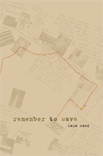
One iteration of Remember to Wave is the poetry book published by Tinfish Press (2010).
Remember to Wave is an inexpert investigation, a pedestrian inquiry. I mapped & remapped a walk near the Expo Center in North Portland as both composition and participatory performance, leading walks of up to 40 people between 2008 and 2010. I was interested in reading this space through this exercise & sustained attention, research & conversation, opening up inquiry. What I immediately noticed became a part of the work, from the Expo Center trade shows to the Roller Derby matches that drew me to the space in the first place.
But the project was also about being attuned to aspects of the geography more difficult to read, what I came to call the the elsewhere & erstwhile, emphasizing the connective thinking of poetry. Reading that space for the erstwhile meant reading it for the history of incarceration of Japanese Americans that happened in World War II. In May 1942 over 3000 people were imprisoned in the Expo Center, what was called the Portland Assembly Center, living in spaces built over animal stalls in this building.
And an erstwhile reading of the space also coaxes up the history of Vanport City, which was built in the floodplain land surrounding the Expo Center when people were imprisoned there, and which housed over 40,000 people who built the ships to fight the war.
more...
“Poet Walks Back into History” by B.T. Shaw, Oregonian
“Poet Kaia Sand helps keep Portland’s troubled history from fading into invisibility” by Carmel Bentley, Street Roots
“Poet Kaia Sand brings history to the present through explorations of space” by Lucy Burningham, Oregon Humanities”
later

This community arts project emerged from Remember to Wave.
And after the war, Vanport housed people who returned from that war–GIs, but also, significantly, some of the people who were first imprisoned in the Portland Assembly Center and then imprisoned inland, and upon release, ended up living in that same area where they were forcibly held, but that land continued to prove repellent, because the city was destroyed in 1948 by a flood.
In this project, context becomes textual, creating constraints and possibilities. Existing signs, such as ones that announce the toxicity of the slough water, become a part of the poetry. Traffic drowns out conversation on a stretch of the walk along Marine Drive, so this led me bring the book back into that space, laying down haiku written in the Tule Lake internment camp, one of the internment camps people were sent from the Portland Assembly Center. Portable Demand Storage Units create situational rhymes.
They are monuments to possessions in a context where Japanese Americans were ordered to only bring what possessions they could carry, and they were stripped of that possibility of storage. And, in a context where people were forced off the land by flooding, the fact that PODS have been turned into makeshift disaster shelters creates another situational rhyme.
Participation mattered in many ways, from the conversations I had with people as we walked to a the more structured participation of the mud slough ode. At the beginning of the walk I distribute a pamphlet with a section for walkers to write down observations (this is now part of the book by Tinfish Press. This culminated in the Mud Slough Ode, on an outcropping of a rock amphitheater along the mud slough off the Columbia River. I choreograph this impromptu poem by gesturing to people to say words and phrases.


September 30, 2008, April 17, 2010, and May 10, 2010
PSU MFA Monday Night Lecture Series. May 2, 2011

-

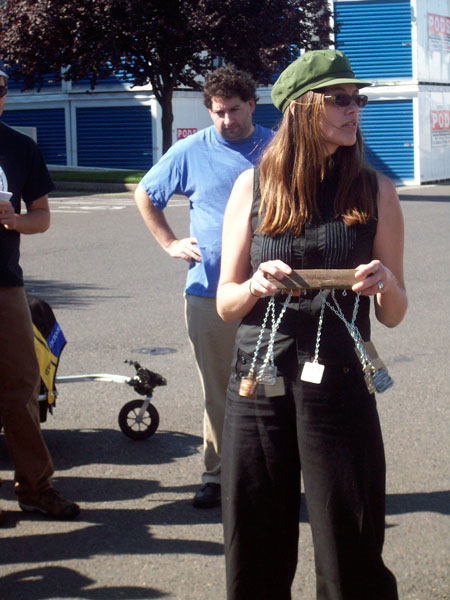
- To signal transitions, I ring chimes (inspired by Valerie Otani’s art) that my daughter and I made from on-site wood and repurposed race metals.
-

- Context is significant to the poem. In this case, the sign describing the contamination of this water reads into the poem.

-

- Near the end of the walk, I choreograph a collaborative ode in a ruined amphitheater

-

- I created the form of the walk by stitching and collaging a map that I provide walkers. It also makes up the beginning of the book.


